
Walking Through a Minefield
Why I Kept My Deconstruction Secret for So Long

This is part of a series. You can read the previous posts in chronological order at my website: James Pence - A Deconstruction Observed
Deconstruction isn’t just a difficult road.
It’s a journey I didn’t choose to a place I didn’t want to go.
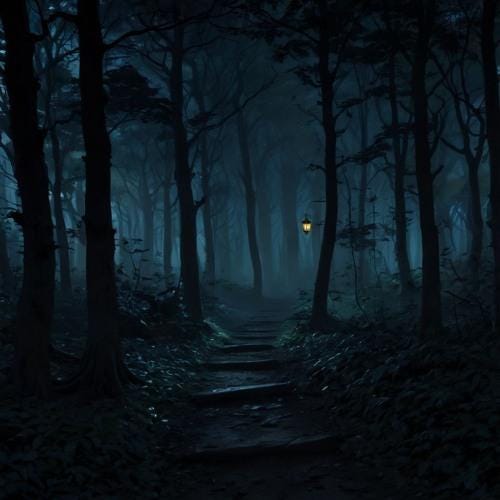
It’s like walking through a dark forest but with landmines
You have to watch where, when, and how you step.
That’s why many people who are deconstructing will never let you know about it. Especially if you and they are in an evangelical church.
I began deconstructing portions of my faith back in the late 1980s, although it didn’t pick up speed and peaked somewhere around 2009. By 2017 I was through the worst of it and had begun the work of reconstruction (i.e. figuring out what I believed as opposed to what I no longer believed).
I told only a few people that I was struggling and rethinking things, and even then I didn’t tell them everything. I didn’t come out of the deconstruction closet until around 2022, when I started blogging about my deconstruction on my website.
Why?
I didn’t feel like I could trust anybody.
I’d been in evangelicalism since I came to faith in Christ as a teenager, and I’d seen over the years the truth behind the adage, “The Christian army is the only army that shoots its wounded.”
I’d seen what happens to someone who questions the doctrine of the Rapture.
Or someone who questions the inerrancy of the Bible.
Or when someone dares to suggest that evolution might be true.
And don’t even mention suggesting that it’s possible for LGBTQ+ people to be true Christians.
Shall I go on? There are others but I think you get the point.
Landmines
I knew that in my world of conservative evangelicalism there was a path to walk and a party line to hold, and to veer from that in any way, to even hint that I was thinking about some of these things, I risked stepping on a landmine.
And by stepping on one of these landmines I risked everything I’d known from the time I was a teenager. I risked losing friendships and relationships, my job, even my identity, which was built around the things I did in the Christian community.
And so I learned to sort through my questions in silence, not risking life and community.
But one day, I stepped on a landmine.
In 2020 I became very concerned about the authoritarian tendencies of Donald Trump and made the mistake of blogging and posting about it on Facebook.
Boom!
The explosion was nearly instantaneous.
I received cordial (at first) but patronizing comments and emails from friends who told me how off base I was in not supporting Trump and how I needed to watch more Fox News. (I was literally told that!)
The more I blogged the more hostile the responses became.
I felt as if I were under assault, and I guess I was.
I dreaded getting online in the morning because one person had the habit of swooping down overnight and dropping bombs.
All meant to “correct” me.
And I was only blogging about politics.
These evangelicals, who perhaps were well meaning, only served to confirm my deconstruction.
If this was how they reacted when they learned I didn’t support Trump, what would they say if I told them that I’d let go of the concept of inerrancy?
Or that I was LGBTQ+ affirming?
Or that I accepted the science of evolution?
I wasn’t ready to handle the pushback. So, I retreated further into the closet and stayed there until 2022, when I finally decided it was time to go public.
Out of the Deconstruction Closet
Why did I finally quite hiding?
First, I was fully retired. So, I couldn’t lose my job and my family would not be adversely impacted by my coming out of the closet. That’s not a noble reason, I know. Many others have sacrificed everything by being honest and I wasn’t willing to take that risk. I’m not proud of that, but there you have it.
The second reason can be summarized by a statement by Andre Gide (later popularized by Kurt Cobain), “It is better to be hated for what you are than to be loved for what you are not.” I’d survived a near-fatal heart attack in 2021 and knew if I didn’t let people know who I was soon, I might never get the chance.
Third and perhaps the most important, I’ve realized along my journey that I am not alone. There are so many others who have been deconstructing their faith that deconstruction is now considered by some to be a fad. (It isn’t.) I feel it’s important for me to add my voice and share my experiences.
Because somewhere out there is another person picking their way through the same dark forest, afraid to ask their questions out loud.
If my story helps them take one more step forward, the risk will have been worth it.
To read my journey in chronological order, go to JamesPence.com – A Deconstruction Observed.
There is no obligation to subscribe. The free essays will continue. But if you'd like to walk a little farther down the trail with me, paid subscriptions help will help me to continue writing for people traveling through the dark forest.
If you'd like to support my work but don’t want to add another subscription, you can leave a one-time tip here:
And if things are too tight (Believe me, I get it!), I’d appreciate it if you could like, comment, restack, and/or share this post. It helps the all-powerful algorithm notice me. :)
Jim, I can identify with a lot of what you’ve been writing about in this series. A lot of my renovations have been shared with my wife and just a couple of other pastors and a few friends honest enough to be transparent about their own experiences. I’m 76 and quite frankly coming out like you have isn’t worth the risk to my mental and emotional health. I admire you Jim and I always take away great thoughts from your posts.
I recently went to the WWI museum in Kansas City and learned that mines and other unexploded ordinance are still in the ground in NE France. It’s called the Iron Harvest. Hundreds of farmers have died in the last 100 years after WWI while trying to simply put food on the table. While at the museum this struck me as a powerful (literal) symbol of intergenerational trauma. Thanks to your deconstruction metaphor I see that it’s also a symbol of the dangers of false teaching.