
When Church Doesn't Feel Safe
The hidden loneliness of faith deconstruction.

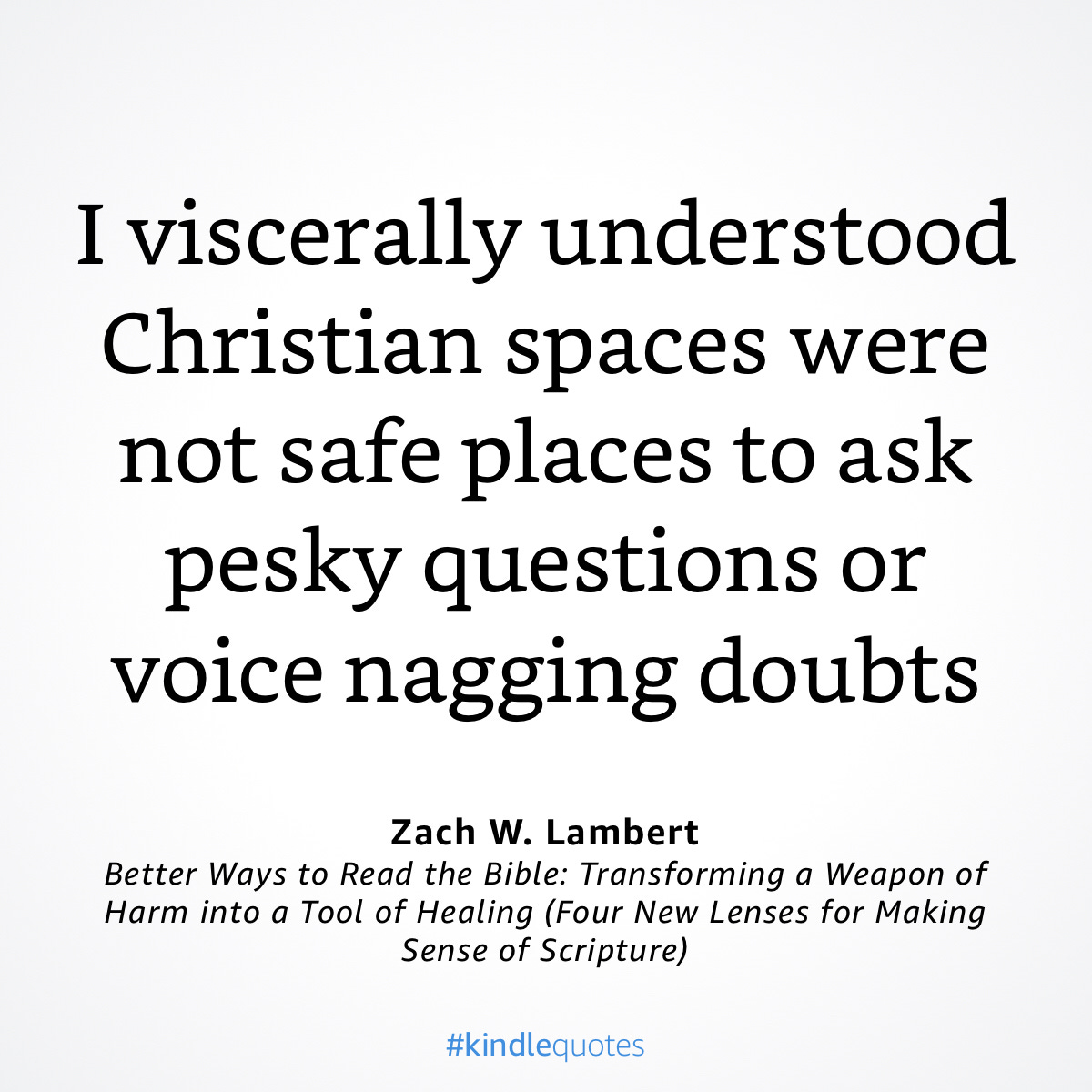
“I viscerally understood Christian spaces were not safe places to ask pesky questions or voice nagging doubts.”1
When I read those words in Zach Lambert’s book, Better Ways to Read the Bible, it was as if he had put into print the thing I never dared say out loud. I lived that experience for years.
I was in ministry, and I was one of the silent ones. I wrestled with questions internally and rarely voiced them. I knew instinctively that admitting publicly that I was having doubts was inviting disaster.
Jesuit priest, psychologist, and author John Powell once wrote, “If I tell you who I am, you may not like who I am, and that is all I have.”2 That sentence captures the fear that kept me quiet in church and among my peers. If I was honest about my doubts I would be exposing myself to rejection.
And I couldn’t risk that.
I had seen what happened to others who spoke up. I remember pastors who lost their jobs for nothing more than shifting their views on the rapture’s timing. They weren’t abandoning Christ. They just saw things differently, and for that they were shown the door.
I watched Christian leaders treat each other with open hostility over matters that should have been secondary. So, I learned to keep my own questions hidden.
Being in ministry only deepened the silence. We evangelicals believed we had cornered the market on the truth. How could I admit to anyone that I was no longer certain, that I was wrestling with things I didn’t know how to resolve?
I feared that if I gave voice to my doubts, I would lose credibility, perhaps even lose the work I loved and the income I needed. So I smiled, I preached, I sang and did prison ministry, all while a private storm raged within me.
For nearly ten years the questions nagged but remained unspoken. It wasn’t safe to let anyone see how wounded I really was.
But it was worse than that.
Not only couldn’t I voice my questions, I couldn’t even explore them. I wrestled with the science of evolution for years, but I wasn’t struggling to understand it or see if or how it might dovetail with my faith. I was fighting to keep the questions out of my mind, shoving them into a lockbox and slamming the lid.
I believed I was being faithful, but in truth I was being intellectually dishonest. I had read plenty of books on evolution, yet every one of them was a polemic written by Christians determined to debunk the science. I had never read a single article written by someone who actually accepted evolutionary theory. Even pulling such a book off the shelf would have felt like betrayal.
Janet Kellogg Ray in her upcoming book, Fish with Feet3 writes: “What most people who reject evolution know about evolution comes from anti-evolution resources.”
That was me.
When I finally decided that I needed to read a book by someone who accepted the science of evolution (long story for another post). I chose a Christian author, Dr. Francis Collins.
As I read Collins’ The Language of God, the floodgates burst. The questions I had tried so long to suppress came rushing in. The flood was devastating, but it did not sweep me away. It launched me on the journey of deconstruction and reconstruction.
Even so, I remained in evangelical spaces for the next eight years, rethinking everything, all the while buried in secrecy.
Why?
I didn’t know where else to go.
I deconstructed quietly. Reading. Studying. Questioning. Changing. Never confiding in anybody except my wife and a couple of trusted friends.
It shouldn’t be this way. The church should be the safest place to voice questions and doubts. But too often it is not. It is all too often a place where you must silence yourself because you fear rejection.
Where you can’t tell people who you are because they might not like you anymore.
If you are in that place, carrying questions you dare not ask, please hear this. You are not alone. I have been there. Others have too.
God is not threatened by your doubts. He welcomes the questions even when the church does not.
Deconstruction for me was like walking through a dense forest at night. Every question was a shadow that stretched across my path. Every doubt was the snap of a branch somewhere in the darkness. I wanted to reach for a hand, to say out loud that I was afraid, but the fear of being shamed kept me silent.
So I walked alone.
Yet even there, in that forest of unasked questions, I discovered I was not truly alone. I could not see him, but God was beside me. My prayer was the only sound I dared to make: “Lord, don’t let go of me. And don’t let me let go of you.”
The church may not always be safe for our questions, but the God who walks with us in the forest is.
We can tell him who we are.
Lambert, Zach W. Better Ways to Read the Bible (Brazos Press, 2025), Introduction.
Powell, John J. Why Am I Afraid to Tell You Who I Am? (Notre Dame, IN: Tabor Publishing, 1969), p. 5.
Fish with Feet: Human Evolution and the Image of God releases August 13th but may be preordered now.
Sounds so much like my experience
Thanks for continuing to share your journey!