
When My Deconstruction Path Ended at a Cliff
The long season where I wasn’t sure what I believed

[NOTE: I’ve covered the main details of my deconstruction but have hesitated to write about the next stage in my journey because so much of that story has to do with events that happened in my past. I don’t want it to read like a boring history (e.g. here are reasons I still am a Christian), so I’ve decided to fall back on my background as a novelist and storyteller. The next stage of my deconsruction will be presented as a narrative. The following piece is transitional.]
A while back I was talking with an atheist friend and describing my deconstruction, and he asked me why I was still a Christian, why I didn’t leave the faith altogether. I had to think about that for a few moments.
After a pause, I said, “The person of Jesus Christ. I couldn’t get past Jesus.”
Often during my journey I’d feel as though I were standing on the edge of a cliff and staring into nothingness. It happened so often I’d coined a phrase to describe it: “I stood at the edge of eternity and beheld only blackness.” It wasn’t just a quaint phrase, though. It was an existential conflict that raged in me for months, if not years.
I had lived in a world of certainty where the God of the universe determined every single event that happened. That world gave me confidence because I could always fall back on the comforting thought, “God has everything under control.”
Even if I didn’t understand the circumstances, I knew that God had not only approved what was happening, he had ordained it. But once I began deconstucting I felt the force of the storms as I hadn’t in years.
I couldn’t brush off tragedies anymore.
Earlier this year the Texas hill country was hit with devastating floods. Many people died. Some of those were children and counselors at a Christian camp. As a former camp director, those deaths hit me especially hard.
There was a time when in response I might have quoted Job: “The Lord gives and the Lord takes away.” I might have said something like, “God, I don’t understand this, but I know you’re in control.” Because I believed that God ordained everything, I would have done everything I could to insulate God from that horror.
Ascribing everything to the preordained purpose of God puts questions of theodicy off to a safe distance. “God works all things together for good for those who love him and who are called according to his purpose.”
End of story. Everything tied neatly in a theological bow.
But after my deconstruction everything seemed so much more random. I couldn’t cherry-pick scripture verses to solve the problem. The old answers didn’t work anymore. That’s why during my worst times in my deconstruction I felt as though I were looking into a black void. It’s why at times I questioned God’s very existence. It’s why I compare that journey to walking through a dark forest. It’s why some people walk away from the faith altogether.
It’s a point of no return. A fork in the road in the middle of a dark forest. One fork led to a cliff; the other led into the unknown.
When I got to that point in my deconstruction process, I knew I had a choice.
I couldn’t turn around. I’d come too far. But instead of leaping off the cliff or going into the unknown, I hesitated. I decided to remain at that decision point, to “camp out” there. Something in me knew instinctively that if I went over the cliff there would be no coming back. And so I stayed at the decision point. I honestly don’t remember how long I camped out there, but it was several years at least.
What did I do?
I prayed: “God, please don’t let go of me. And don’t let me let go of you,” a lot!
I spent a lot of time reading the Bible and reading authors I previously had dismissed out of hand. I sought to understand different views, digesting different perspectives on the Bible, evolution, and theology.
I also reflected on what God had done in my life in the past.
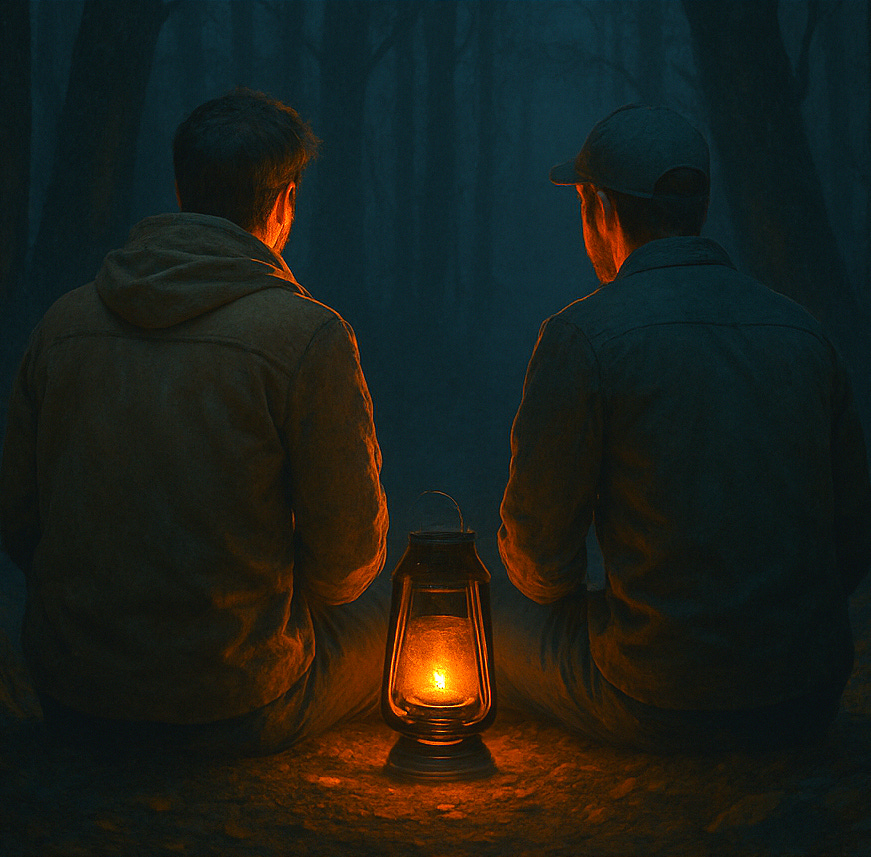
One day a stranger came along the road and asked if he could sit down with me.
We sat together for a long time. I didn’t know it at the time, but that stranger was Jesus. After a while he stood up and invited me to follow him the rest of the way through the dark forest. And as we walked together, I began to understand that even though I was rethinking everything, there was one constant, at least for me.
He was walking through my deconstruction with me. Since that time, my journey of deconstruction has been a journey of reconstruction. The forest is still dark at times. But I’m not walking the path alone.
Jesus didn’t block my way. He joined me on my journey.
I couldn’t get past Jesus.
A compelling narrative and although my journey is somewhat different the bottom line for me is also Jesus and the magnitude of His grace and mercy at work in my life even in the darkest moments. Thank you Jim. Correct me if you would rather be called James. I appreciate you.